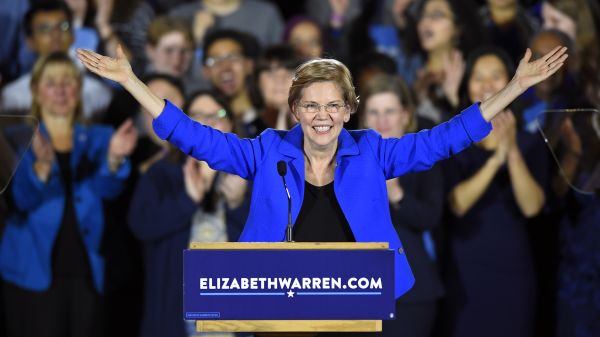
It’s official, the first major player from the Democratic party is running for president. On the eve of the new year, Elizabeth Warren announced that she would be forming an exploratory committee to run for president. While this is not an official announcement, she is all but telling us that she’s running. Along with her twitter announcement, she released a moving and very powerful video explaining her reasoning for wanting to become the next president of the United States. Many progressives have called on the Senator from Massachusetts to run for president since the 2016 primaries, and now we will see if Elizabeth Warren can pull it off.
Warren was born in Oklahoma City to modest middle-class parents. Her father worked at Montgomery Ward and as a maintenance man. After her father had a debilitating heart attack and was unable to work, her mother started working at Sears to help pay the bills. At 13 years old, Warren started waiting tables at her aunt’s restaurant to help with the family’s income. In 1968 she married her high school sweetheart, Jim Warren, and received a Bachelor of Science from the University of Houston two years later in 1970. After moving with her husband to New Jersey, she enrolled in Rutgers Law School at Rutgers University-Newark. After graduating in 1976, she wrote wills and real estate contracts for clients out of their home. The couple had two children but divorced in 1978. Soon after she remarried Bruce Mann but kept the name of her first husband.

Elizabeth Warren has taught law at several universities including: Rutgers University, the University of Houston, Texas, Pennsylvania and most recently Harvard Law School. Warren quickly became an expert in bankruptcy and commercial law. In the 90s, she worked to protect consumers as an advocate on the National Bankruptcy Review Commission. In the aftermath of the recession of 2008, Harry Reid appointed Warren to a Congressional Oversight Panel to monitor the government’s handling of the financial crisis. Her work on the committee led her to advocate for the creation of the Consumer Financial Protection Bureau (CFPB), which she later helped to formally establish. In 2010, after the death of Senator Ted Kennedy, Warren was elected as the first female Senator from Massachusetts in a special election.
Although a former Republican, Warren has been a darling of the progressive wing of the Democratic party since her election to the Senate. While she advocates for many progressive issues, her main focus has been on banking and the financial sector. Videos of her relentless questioning of Wall Street executives have gone viral and have been shared by thousands. Following the crash of 2008, she has repeatedly called for the resignation and criminal investigation of banking executives. In October of 2017, during a Senate Banking Committee hearing, Warren called out Wells Fargo CEO, Tim Sloan, stating “At best you were incompetent, at worst you were complicit”.
The progressive and feminist battle cry, ‘Nevertheless she persisted’ has been attributed to Warren and other female leaders. It originated from the Senate confirmation process of Jeff Sessions to Attorney General of the United States by President Donald Trump. During debate on the Senate floor, Warren objected to his appointment and began to read a letter written by Coretta Scott King in 1986 when she opposed the nomination of Sessions to be a federal court judge. A Republican Senator interrupted her and reminded her of a Senate rule against attributing “to another senator or to other senators any conduct or motive unworthy or unbecoming a senator.” Warren was unfazed and continued to read, but Majority Leader McConnell instructed the Senator to cease and have a seat. A vote along party lines silenced Warren for the rest of the hearing. McConnell’s own words were used as a rallying cry — “Senator Warren was giving a lengthy speech. She had appeared to violate the rule. She was warned. She was given an explanation. Nevertheless, she persisted.”
Two important pieces of legislation put forth by Senator Warren are the Anti-Corruption and Public Integrity Act and the sweeping Accountable Capitalism Act. The Anti-Corruption bill is aimed at curbing corrupt campaign spending and getting money out of politics in all three branches of the federal government. The bill would place a lifetime ban on lobbying for presidents, vice presidents, federal judges, members of Congress, and cabinet members and a multi-year ban for federal employees. It would force presidents to place all assets in a blind trust and require candidates to release a certain amount of tax returns in an effort to prevent conflicts of interests. The bill would also change the rule-making process to restrict corporate influence on law-making. Most importantly, the bill would create a new independent office that would investigate and enforce rules of ethics.
The Accountable Capitalism Act is far more important in that it is one of the most sweeping bills to combat corporate power in decades. The basic premise of the bill is that if corporations claim the legal rights of personhood, following the disastrous Citizens United Supreme Court Case, then they should also accept the moral obligations as well. Currently, corporations have prioritized shareholders and enriching their bottom lines over the very workers that make those profits possible. Her bill puts more power in the hands of those very workers and ensure they have a voice in business decisions, not just shareholders. The law would require businesses with profits over $1 billion – a small group, but with a large share of economic activity and employment – to allow workers to elect 40 percent of the membership of their board of directors. The bill also requires executives to wait at least five years to sell stocks that are received as pay compensation in an effort to disincentivize stock buybacks as a way to enrich their own pay instead of investing in workers and the business.
Elizabeth Warren is better known for her progressive populism, but she also supports many other ideas that will excite Democratic voters. The Senator has said she supports new hot topic policies like Medicare for All and a Green New Deal. She is pro-choice and a strong supporter of reproductive rights. Warren is equally as supportive of the LGBTQ community, supporting same-sex marriage and passage of the Employment Non-Discrimination Act. In 2015, she was one of several Senators to write a letter to the FDA asking them to lift the ban on gay men from donating blood saying it perpetuates the stereotype that all gay men pose a health risk to the rest of society. She supports an overhaul of the criminal justice system, calling it a racist and prejudiced against black and brown Americans. Warren has also advocated for the rights of states to legalize marijuana.
While there are many things for progressives to love Elizabeth Warren for, there are a few things that have made the left stop and question. The Senator from Massachusetts was noticeably silent when water protectors from the Sioux Tribe were protesting the construction of the Dakota Access Pipeline near Standing Rock Indian Reservation. Members from the tribe and protesters from around the country were brutally assaulted by local police using extreme force and fire hoses during below freezing weather. Future Congresswoman, Alexandria Ocasio-Cortez attended some of these protests. She did eventually release a statement in support of the water protectors, but many said it was a little too late, waiting until President Obama halted construction. Many on the left were also disappointed that the Senator didn’t endorse and support Bernie Sanders during the 2016 primary season, waiting to endorse Clinton until she had all but wrapped up the nomination. With Sanders losing Massachusetts by only 1.2 percent, many claimed the endorsement from one of the most loved members of the progressive wing of the party could have pushed Sanders to victory. People on the left also worry about Warrens foreign policy. In 2017 she voted for a whopping $700 billion budget for the military, way more than the Pentagon or even President Trump asked for. When it comes to Israel and Palestine she says she supports a two-state solution but adds that Palestinian application to the UN doesn’t help the peace process. If I may add, nothing but a clear and adamant condemnation of the treatment of the Palestinian people by the Israeli state is short of moral and just.
The announcement of Warren for president has been met with cheers and relief from Democrats of all shades. Warrens voice will be sure to add a needed momentum and continued economic push leftward of the Democratic party. For too long the Democratic party has lost sight of what really matters, creating a society in which every voice is valued. The New Democrats of the 80s and 90s traded corporate power and money, tossing the interests of the working class to the wayside. The prospect of the first woman president is also sure to bring voters to the polls. With a few other female candidates rumored to run as well, Elizabeth Warren will have to find a way to make herself stand out. Her relentless pressure on corporate power will motivate and excite Democratic voters, but will it be enough to set herself apart in a crowded field of candidates. Only time will tell, but as it stands right now Elizabeth Warren will quickly become a frontrunner.
Dale Seufert-Navarro
 to the LEFT