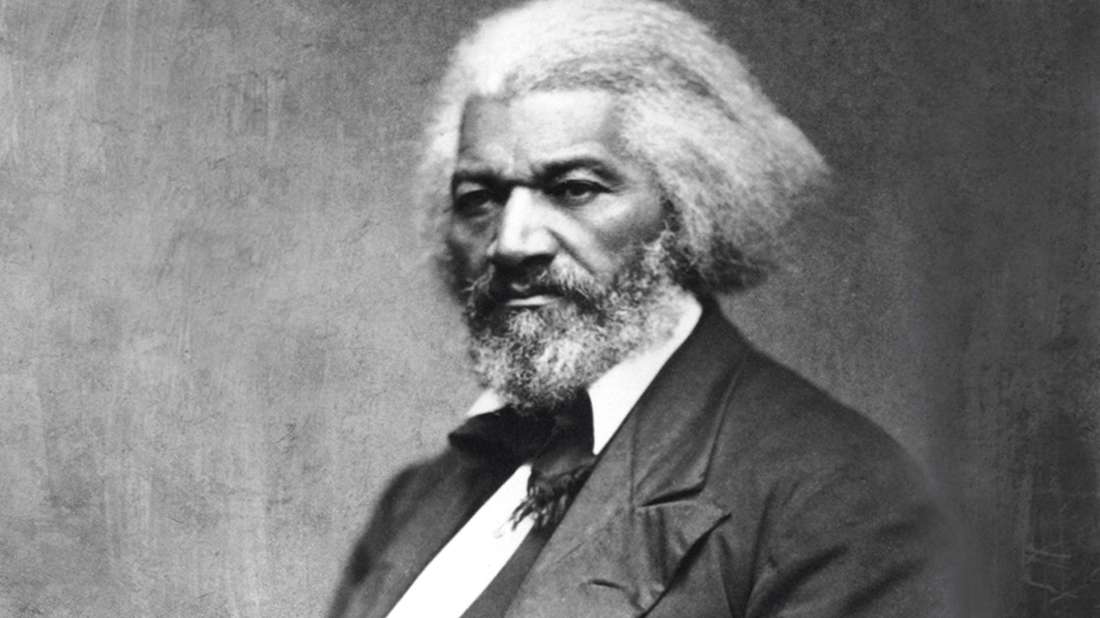
This month we not only celebrate Black History Month, but the birth month of one of our nations most respected activists, Frederick Douglass.
Douglass was born as a slave on the Chesapeake Bay of Maryland. While the exact date of his birth is unknown, many choose to honor him on the 13th or 14th of February. He escaped his slave status and became an activist for the abolition of slavery. Perhaps the greatest wisdom and strength of Douglass was his understanding of the intersectionality of race, class, and gender. In a time when slavery was the law of the land and women suffrage was a mere dream, this is very extraordinary.
Frederick Douglass not only worked towards the abolition of slavery and the racial equality of freed slaves after the Civil War, but he advocated for the right of women to be equal members of society as well. The Northern Abolitionist movement was full of women so this no doubt influenced his view on the matter. He was once quoted,
“When the true history of the antislavery cause shall be written, women will occupy a large space in its pages, for the cause of the slave has been peculiarly woman’s cause.” [Life and Times of Frederick Douglass,1881]
In a time when most men would have felt emasculated in being associated with the womens rights movement — this is also true of today — he took pride in this title.
“…caused me to be denominated a woman’s-rights man. I am glad to say that I have never been ashamed to be thus designated.”
In fact, Douglass joined Elizabeth Stanton and Susan B. Anthony in forming the American Equal Rights Association in 1866. The group called for universal suffrage at the Women’s Rights Convention of Seneca Falls in 1848, where he was a guest speaker.
Douglass also understood the importance of poverty and class solidarity. In 1866, Douglass traveled to the White House to speak with President Andrew Johnson about black equality and suffrage. At the time, Johnson did not want anything to do with the issue. In his mind, this would embolden neo-Confederate restoration. Douglass offered a different vision, one that combined disenfranchised blacks and poor whites in the south.
“Let the negro once understand that he has an organic right to vote, and he will raise up a party in the Southern States among the poor, who will rally with him. There is this conflict that you speak of between the wealthy slaveholder and the poor man.”
Here Douglass understood that while racial animus was real, it was partly due to the division sown by wealthy elites to divide all of the poor, black and white. This is very much the case still today.
Douglass understood that the institution of slavery was not only due to racial supremacy but also because of financial incentives. He was also able to see the lot of women in society was just as entangled in this capitalist patriarchal system.
This ability to see the intersectionality of all of these issues is just as important today as it was in the late 1800s. In some way it is even more important. We like to think that we have evolved past some of these things, but that is simply not the case. Better, but not perfect. The prevailing case of sexism thrives not just on social media but in everyday life. These sexist and racist attitudes can not be blamed on social media alone. In fact, these new platforms are simply mirrors of our deep seated perverseness. Social media has its own problems, for sure, but to argue that they are a cause is yet another case of the strawman. We should use them as a way to highlight what through history as been veiled and not so apparent.
It is sad that so much time has passed since the time of Douglass, and yet we still seem to be reckoning with so many of the sins of that time. In a time when solutions to societies ills seem so hard to decipher, we should lift up voices like Frederick Douglass. A man that understood that it is not just one or the other, but a combination of things. We should strive for all forms of justice — racial, economic, sexual, and gender based. We should also understand and accept that these things permeate all of us whether we think so or not. Instead of fighting this we should accept and embrace it. Go through to get through to the other side. We have to face these injustices in all of their forms, whether personal or societal. This is the only way that we can begin to understand and evolve as a society.
Dale Seufert-Navarro

 to the LEFT