
French Protests reveal Growing Unrest

the new york times
Protests near the Arc de Triomphe – The New York Times

The most recent protests in France should worry the American political elite. The unrest was initially sparked by new fuel taxes but draws its energy from years of harsh neoliberal governance. Support among the numbers of protesters are vast, with many sides of the political spectrum trying to claim rights and co-op the movement. American political leaders, and specifically the Democratic party, should learn from these demonstrations and try to understand the roots of this turmoil.

As stated, the protests were first initiated by the French government’s announcement of new fuel taxes. The price of fuel has risen about 23 percent since the beginning of 2018, and around November, President Macron announced new taxes on fuel that would further raise prices. The cost of a gallon of diesel – the most used form of fuel for cars in France – is about $6.53 (USD). The hike in prices most heavily effects people that live in more rural areas that have to commute for work and school. This also comes at a time when continued cuts to public transit make people more dependent on their cars. On November 17th , 2018, frustration turned into action. Thanks to a grassroots online movement, thousands of people took to the streets to voice their opposition to these rising gas prices. The protesters wore the bright yellow vests that all motorists are required to keep in their cars by law.

The new taxes were supposed to be a part of the government’s new environmental agenda, which Macron said were necessary to protect the environment and combat climate change. What eventually became known was that only a mere 20% of revenue raised by the new taxes would go to environmental programs. The government used the pretext of climate change to further pillage the working class. This comes at a time when the working class of France is struggling to survive. After years of cuts and austerity, the middle and lower classes of French society are being economically suffocated. This can be traced as far back as 1983 when the government at the time enacted controversial austerity policies. This trend has continued ever since, with the French social welfare state being slowly chipped away. This mirrors events in the U.S. and the UK with Ronald Reagan and Margaret Thatcher. More recently, Macrons government has been criticized for an agenda that favors the wealthy over working class people.

Emmanuel Macron, a banker with a career in finance, won his bid for president in a landslide that was partly due to the fact that he ran against an evident racist, Marine le Pen. The young charismatic politician ran as the anti-Trump, but also tried to separate himself from the French political establishment which, like the U.S., is not very popular at the moment. Macron was endorsed by President Obama and heralded as a progressive savior. His time in office has proven that this couldn’t be further from the truth. His government abolished an important tax on the wealthy, the Solidarity Wealth Tax, which was a boon of $4 billion dollars to the richest members of French society. In his 2018 budget, he established a flat tax on capital which allowed an additional $10 billion to be transferred to the upper class. At the same time, Macron has led an assault on labor unions and cut services that average French citizens depend on. He raised income taxes on pensioners while also stopping these pensions to be indexed for inflation. The government has also lowered the amount given for housing contributions to people struggling to meet housing demands.

This is nothing more than a literal redistribution of money from the bottom to the top – socialism for the rich with harsh rugged capitalism for the working class and the working poor. This is also similar to what is going on in the rest of the world, the U.S. included. The new fuel taxes have proven to be the final element in a long line of measures that are strangling the working class in France. This fight has brought many parts of French society together in solidarity. The makeup of the protesters is broad, with most of the participants saying they have never participated in any kind of protest before. A completely grassroots movement, it has no official leader and no organizational structure. This has unfortunately allowed nefarious groups to try and co-op the movement. The French far-right was quick to latch onto the protests and insert its brand of anti-tax, anti-environmental and even anti-immigrant rhetoric. Even the American right quickly claimed that the movement was due to high taxation and anti-environmental sentiment. Fox news ran stories making these claims with President Trump parroting them soon after. While the American media and French far-right has tried to paint this movement as big government gone wrong, the broader complaint is of the unfair tax system where the rich have done very well under Macron.

While a specific tax prompted this unrest, the French people are not opposed to progressive taxation and efforts to protect the environment. Polling shows that both are important to French citizens. The grievance is that both are being unevenly shouldered on the working class and not the rich. The burden of alleviating climate change instead should be shifted to the large corporations that are most responsible for climate change instead of the most vulnerable members of society. The attention of the protesters soon turned to Macron himself. His reputation and policies had already dubbed him the ‘president of the rich’, and his harsh response to the movement didn’t help. Many of his statements showed his disdain and lack of empathy for the working class and the poor. In one speech he stated he loved train stations because there you can cross paths with ‘people who succeed’ and ‘people who are nothing’. In the French media it was reported that he told an unemployed man that instead of ‘kicking up bloody chaos’ he should go find a job, unable to fathom that the very reason for much of this unrest is lack of well-paying jobs and the cutting of the programs designed to aid average citizens. His arrogance and tone-deaf response have prompted the protesters to call for his resignation.

the guardian
President Macron – The Guardian 

Sensing an unsustainable path because of civil unrest, the government conceded on some of their plans – even though Macron and his government initially vowed to never give in. The president announced that the scheduled fuel tax would be postponed, and the minimum wage would be raised. Most ironically, when Macron announced these changes he did so in a gilded golden room of the Élysée Palace. The optics of this could not have been worse for someone that is already seen as out of touch and disdainful of the working class.
medium

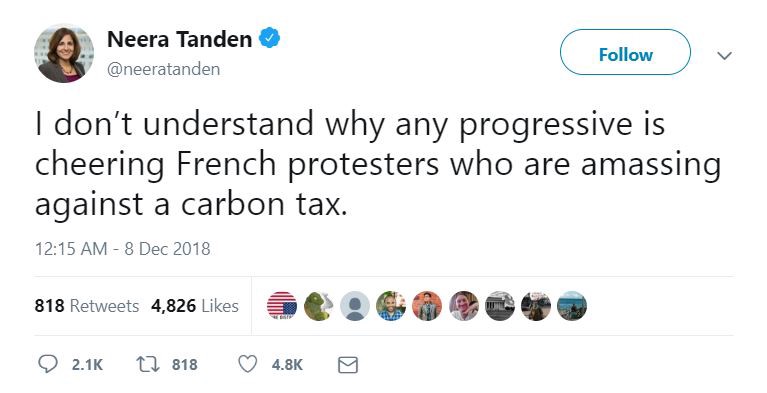
Sadly, some in the American liberal and Democratic establishment rushed to side with Macron and the Carbon tax. Neera Tanden, the President of the Center for American Progress – a third way centrist liberal organization, tweeted: “I don’t understand why any progressive is cheering French protesters who are amassing against a carbon tax.” These elitist so-called progressives are out of touch with working class people and are unable to realize that people are struggling and morally shouldn’t shoulder the burden of climate action, especially given the fact that large multi-national corporations are primarily responsible for the effects of climate change. Journalist Glenn Greenwald commented on these reactions, “The inability of rich neoliberal centrist elites in western capitals to understand – or even hide their scorn for – the anger & grievances of rural and working-class people over their economic suffering is one of the 2 or 3 most important causes of contemporary political changes.”

Growing income inequality and mistrust of the government’s ability to have the best interests of working people will only lead to more unrest. Martin Luther King repeatedly said that riots were the language of the unheard. When everyday citizens believe that they have no real channel to voice their opinions or anger, they have no other option. These protests are the result of this frustration. We must stand in solidarity with working class people around the world and work towards creating an international movement for the fair and just society we want to live in. The protests in France should be a lesson to the rest of the world and more specifically to the American political elite. The insurgent campaign of Bernie Sanders on the left shows people are unhappy with the direction of the establishment of the Democratic party. The embarrassing defeat of Hillary Clinton to the most disliked and scandal ridden candidate, Donald Trump, is proof that 30 plus years of crushing neoliberal politics has taken its toll on society. People are hungry for real substantial change. This is why Americans voted for the ‘hope and change’ candidate – Barack Obama. While Obama saved the country from falling off of an economic cliff, he didn’t go far enough, a corrupt and Wall Street funded Democratic party didn’t go far enough. It has been 10 years since the Great Recession began and the wealthy have recovered and are doing very well, while the rest of us are fighting over the scraps of whatever the rich decide to throw to us. People see this. People feel this. This is one reason, among many, why Donald Trump was able to win the presidency. Trump is but a symptom of a rigged system that will only get worse if substantial changes are not made. We cannot simply revert back to the status quo that was before Trump. If we do we will only be inviting the next Trump to take power, only next time we may get an intelligent and skilled politician instead of a bumbling imbecile.

Dale Seufert-Navarro
Amazon… Can we talk?

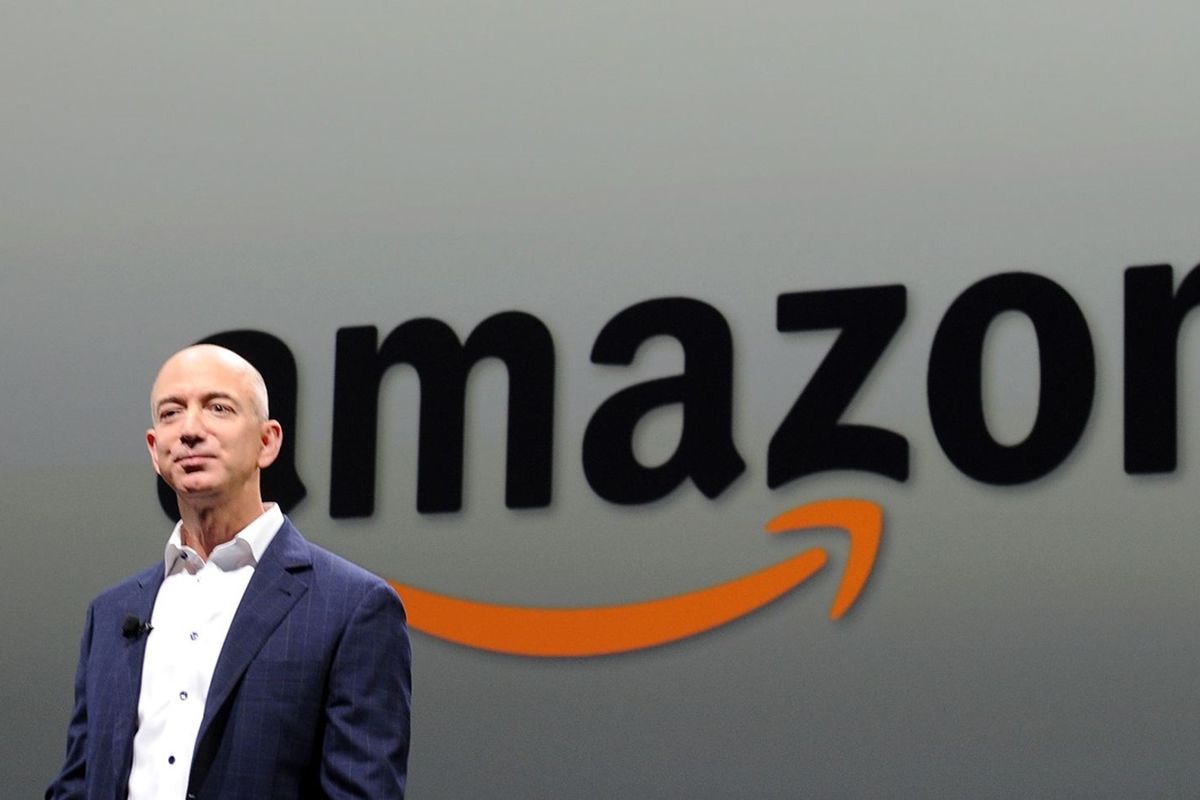
Amazon CEO Jeff Bezos AFP : Getty
Jeff Bezos, Amazon CEO Fortune 

With online shopping sales quickly outpacing brick and mortar sales, one online retailer stands above all the rest. As Amazon’s sales skyrocket so does their reach and influence. Amazon was founded by Jeff Bezos in 1994, and it quickly became a giant in the online shopping market. In 2017 Amazon brought in almost $180 billion dollars in sales, with Jeff Bezos’ net worth topping $100 billion. As its sales grew, so did criticisms about its business practices and its effects on local economies. Working conditions of its warehouse workers, potential monopoly accusations, and its effects on local housing markets have been the most frequent criticisms against the company. As the U.S. is currently in the midst of an affordable housing crisis, large cities all over the country are seeing a spike in homelessness and overpriced housing options. From San Francisco to New York city, gentrified neighborhoods and skyrocketing rents are outpricing residents, pushing them out of their own cities. As news is surfacing about Amazons new headquarters in Virginia and New York many people are wondering what will happen to the area in which these facilities will be built, especially since these two areas are already expensive at the moment.

For some insight into the potential effects of these new Amazon headquarters we can look to Seattle, Washington which has had an Amazon headquarters since 2007. A former classmate of mine, Shenetta Sims, has been living in the Seattle area since 2015.

It has now been some time since Amazon announced that its secondary headquarters will officially be split between Long Island, New York and Alexandria, Virginia putting home buyers, apartment owners, and businesses in a flurry to capitalize on the impending commercial boom. Virginia Tech has already announced a new innovation campus to offer a hub of talent to choose from. Amazon employees are rushing to buy homes in both cities (some before the official announcements), and some Metro stations are already in the process of obtaining facelifts to support this new influx of people. Things seem to be looking up for both cities in anticipation of the move, but some are rightly concerned as to what this could mean for the infrastructure of their respective cities. In order to understand the possible impacts of a behemoth company like Amazon, we only have to study Seattle’s rise in the past ten years from its reputation as a musically inclined fishing hotspot to a technological powerhouse. 

Amazon announced Seattle as its headquarters in 2007 during which time the city was home to nearly 600,000 residents and home sale prices hovered around a median of $390,000. It’s worth mentioning that while Microsoft already had an office about 20 miles away in Redmond and Google would also establish an office in 2009, 13 miles away in Kirkland, Amazon was the first major technologically based company to move centrally into Seattle. Since then the city has experienced a growth explosion that has yielded new restaurants and entertainment that people flock from all over the world to enjoy. This is reflected in tourism rates which have risen around 5% annually between 2010 and 2016 bringing billions in city revenue. It’s a great time to live in Seattle…if you earn well over the average income of $82,000 per household. Many of the new experiences coming to Seattle are cost prohibitive. Seattle’s median home sale prices have skyrocketed to a peak of $720,000 in January of 2018, rent prices have increased by 62%, and homelessness among people living without any sort of adequate shelter has more than doubled. The result is that many Seattleites who once called the city home are pushed farther into the suburbs and surrounding cities which are in turn experiencing their own cost of living increases and loss of diversity. The city of Seattle, realizing that they were facing a crises on their hands, did attempt to remedy this situation by passing a head tax bill which would charge any business grossing more than $20 million a year to pay a tax of $275 per Seattle employee which would then go towards helping combat the homeless and housing the problems the city was facing due to the business influx. However major corporations in the city protested by hiring a consulting firm with ties to President Trump’s campaign to gather signatures in protest. Amazon in particular shut down all construction in Seattle forcing the city to repeal the tax less than a month later.  This is leaving us with a city that is struggling to maintain its identity as it’s pushed closer and closer to something akin to San Francisco.

With these effects in mind, it is understandable to view the new announcement with trepidation if you are someone living in Alexandria or Long Island City. Amazon, like many other large-scale corporations, does have a history of less than ideal business practices and treatment of workers which both cities should anticipate and address as the move occurs. However, as someone who has moved to Seattle from Virginia, I believe that the experience will be much more positive in the new cities. Not only do they have what is essentially a play book of Amazon’s practices going back ten years, but the cities themselves are established in handling large scale industry that is much more diversified than what we have in Seattle. Infrastructure is already in place to handle the mass amount of people moving around two of the nation’s biggest cities, and the current transient nature of Seattle’s population would be nothing new to the areas. In addition, the main tech industry hubs have been largely centered on the West Coast until now, creating a specific culture that will be interesting to see with a more East coast influence. In conclusion, I believe that the move will be mostly exciting for the people in the affected areas. But it will be up to these people and their governments to not be blinded by the increase in revenue and to force companies to maintain a standard of doing business in the area that will protect the most vulnerable; something that would be best accomplished by all three cities working together to put pressure on Amazon to do the same.  — Shenetta Sims

While most commentators on the left are critical of Amazon and skeptical of the complete benignity of the company’s intentions there are some conservatives who are also weary of Amazons influence on local communities and the market at large. Patricia Neil is a conservative that lives outside of Boston, Massachusetts and works in the pharmaceutical industry. As a former resident of one of the newly announced Amazon headquarters in Crystal City, Virginia, she also has a good idea about the potential effects of the company’s new headquarters.

Being that Crystal City is a gateway to Washington D.C., it is already densely populated and congested. There are no shortages of job opportunities in the area as well. An Amazon site is going to be a traffic and population nightmare for Northern Virginia, which already has these issues. Since there isn’t an unemployment problem in Northern Virginia a windfall like this would have been more beneficial in other areas of the state or country. Since Northern Virginia is very expensive to live in already I would be very curious to see an impact analysis on the area. The majority of jobs that will be brought to the area will be lower to middle incomes. These people will not be able to afford housing in the area of the headquarters so will have to commute long distances to work. The commuters from the Fredericksburg area, central Virginia, and Maryland will tax the already maxed out highway system and Wilson Bridge.

Apart from the impact on local communities there is a debate to made about the use of subsidies by states when trying to entice corporations to move to a specific area. Any state that is giving subsidies to Amazon or the optics of Amazon even asking for subsidies is somewhat reprehensible given that they are now a $1 trillion company. As a conservative and a capitalist, unfortunately this is capitalism at its worst. The bottom line is when you’re that powerful you have a choice, you can have your power do something good or you can have that power run the table. I think Bezos is letting his influence run the table, otherwise why would he put a distribution center in Northern Virginia and take subsidies from New York. The part that really bothers me about this deal is that you know there was a room full of bean counters figuring out what the earnings per-share would be as a result of building in Northern Virginia and New York with the subsidies versus say going to a more economically depressed area. We’re talking about cents on the dollar for a company of this size. So, for a cents on the dollar impact on your earnings per-share they would rather have that earnings per-share be a couple cents more than put something in a place that could really benefit from it.

At the end of the day we’re talking about cents on the dollar translating into earnings per share and stockholder value. There is no question that Bezos could’ve gone somewhere that would have had a better economic impact on the local community. Honestly as a conservative I’m offended by how Amazon is behaving. I believe Amazons game is a monopoly, and it’s only a matter of time before the federal government steps in, not unlike the government did with Microsoft. Jeff Bezos should take a page out of Bill Gates playbook and learn from the example set forth by the monopoly rulings of Microsoft. — Patricia Neil

While Amazon, and its two-day prime shipping, has helped to foster a world of convenience, there needs to be a larger discussion about its effects on communities and our economic society at large. Do we really want a company as large as Amazon having as much power as it does, with its tentacles reaching far into every aspect of our lives? Is it time for the government to step in and more heavily regulate Amazon? Is Amazon slowly becoming a monopoly? These are hard questions that need to be asked and investigated. The real question is, will we as a society ask these questions before Amazon gains too much power and it is too late?

Dale Seufert-Navarro

Contributors: Shenetta Sims, Patricia Neil


Let the Journey Begin!

“Be the Change you wish to see in the world” – Anonymous 

“Activism is my rent for living on this planet.” – Alice Walker


These two quotes have been guiding lights for me in my life. When I look at the world around me and the volatile political climate, it fuels something in me.

The working class in this country is being devastated and pushed out of the political discussion. Income inequality and the gap between classes is greater now than during the Gilded Age of the early 20th Century. The growing power of the individuals at the top of the economic sphere is suffocating the voices of everyone else at the bottom. It is clear now that our government is controlled by the interests of the wealthy and giant corporations. 

The planet we live on is neglected and abused. Rivers and streams are being polluted. Oceans are being filled with trash and sea levels are rising. Forests are vanishing. Extreme weather is devastating communities. To put it bluntly, climate change is the most pressing issue we face as a civilization. It is an issue that we must tackle with every will and resource that we have.

We live in a world where, for all of its progressions, people of color are still being marginalized. Our criminal justice system is unfair and unbalanced, divided on the lines of class and race. Wealthier individuals living by a separate set of rules, are given immunity from the consequences of life. People of color and the poor are living under a more harsh and unjust set of rules. Police violence more greatly effecting minority groups.

Voting rights and political participation are under assault. More and more obstacles of having a say in the political process are put into place, election after election. We should be making it easier to vote, not suppressing one of the only ways average people have a say in the kind of society they want to live in. The way campaigns and elections are ran must be reformed and democratized. Large sums of money from wealthy individuals and corporations are drowning our democracy and the voices of everyday citizens.

Anger is a very powerful emotion, but anger can also be counterproductive if not channeled in the right way. Honest discussion and debate are needed and necessary, but petty name calling and personal attacks don’t solve anything. I hope this safe place can become a home for a larger progressive movement, but all are welcome, conservative and progressive alike, to contribute in this discussion. I want to make a difference in the world; to be the change. I want to start a conversation.

For economic equality! For campaign finance reform! For reproductive rights! For climate action! For criminal justice reform! For labor solidarity! This project is but one small step in making all of this possible. One small candle in a sea of darkness. 

Will you join me?

Dale Seufert-Navarro