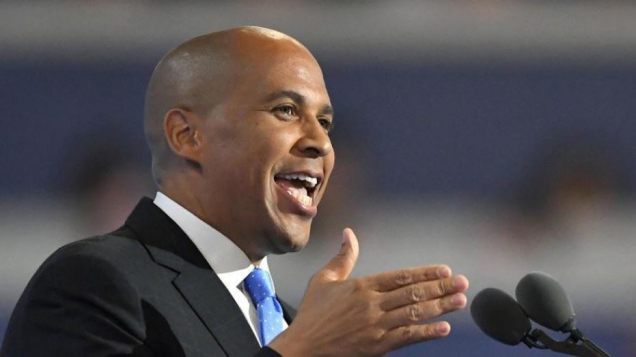
On February 1st, Cory Booker joined a quickly growing list of Democratic candidates running for the presidency. His announcement video draws on his time as mayor of Newark, New Jersey and calls for a return of ‘civic grace.’ Booker points to his unique path in politics, claiming that it is just what our country needs at this rough moment in history. He is a gifted orator and certainly knows how to use a media platform to his advantage. Some parts of his political past are quite interesting, but some on the left remain skeptical of his progressive intentions.
Cory Booker was born in Washington D.C., but grew up in Harrington Park, New Jersey. Booker received a degree in Political Science and a Masters in Sociology from Stanford University. He also attended the University of Oxford, studying American History, and Yale Law School, receiving his Juris Doctor.
His political career started in 1988, when he successfully won a seat on the Municipal Council of Newark. It was during this time that he tried to highlight problems facing urban development. Booker went on a 10-day hunger strike, lived in a tent in the inner city of Newark, and began a week-long challenge to live on $30 food budget – the amount of SNAP benefits recipients receive. The new councilman’s proposals – initiatives to help young people, people of color, affordable housing, and transparency of local government – were routinely outvoted by his fellow members. In 2006, Cory Booker won his race for mayor of Newark, bringing with him a bench of council candidates that became known as the ‘Booker Team’. This gave the new mayor a strong mandate to govern. A central focus of his time as mayor was crime reduction, increasing police forces and working hard to get illegal guns off the streets of Newark. His tenure saw the increase in the amount of affordable housing, increased wages of city workers – while simultaneously reducing his own salary, and the institution of open office hours where residents could regularly meet the mayor to discuss concerns.
Booker gained lots of national media attention during his time as mayor. He once shoveled snow from an elderly resident’s drive way, rescued a woman from a burning building – receiving mild burns and smoke inhalation, and invited displaced residents into his home after Hurricane Sandy destroyed much of the shoreline. Many have claimed that Booker is a master of social media and the attention it brings, using these platforms to elevate his profile. While this may be true, that he seeks out ways to enhance his brand for opportunistic personal reasons, these incidents are noble nonetheless and should be praised and acknowledged.
In 2013, Cory Booker became the first African-American Senator from the state of New Jersey. His time in the Senate has been a mixed bag with the Junior Senator voting for some very good legislation yet, he has drawn criticism from progressives for other votes and campaign fundraising.
On a positive note, Booker co-sponsored and voted for the Employment Non-Discrimination Act and the Respect for Marriage Act – repealing DOMA and requiring the federal government to recognize same-sex marriages. He has been relentless in his opposition to the Trump administration, voting overwhelmingly against the presidents’ nominees and even testifying against fellow Senator Sessions when he was nominated to U.S. Attorney General. Perhaps his most notable achievement recently was his work in getting the First Step Act, an important bipartisan criminal justice reform bill, passed and signed by President Trump. Booker is a proponent of ending the failed ‘War on Drugs’ and supports medical marijuana research as well as decriminalization. The Humane Society has called the Senators voting record the most pro-animal in Congress. Interestingly the Senator has been a vegan since 2014, and a vegetarian for over 20 years.
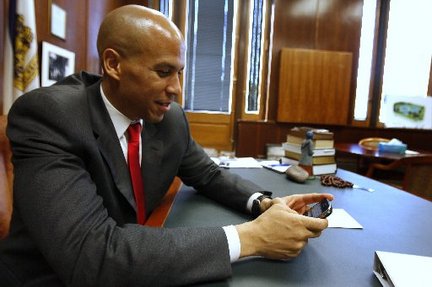
Most of Cory Bookers criticism from the left is not about his views on social issues but his fundraising and close ties to the financial and pharmaceutical industries. In 2017, Booker, along with 12 other Democrats, voted against a bill allowing Americans to buy prescription drugs from Canada – where the exact same drugs are significantly cheaper. Walter Bragman at Paste Magazine stated, “This is classic Booker – stand out front on feel-good social issues… and align with big money everywhere else.” It is interesting that Bookers home state of New Jersey is home to many pharma headquarters, and the Senator received about $57,000 from pharmaceutical PACs in 2016. But in 2014, an election year that he actually ran in, he received $160,000 from the industry. To Bookers credit, the Senator has recently come out in favor of a Medicare for All system, cosigning Bernie Sanders’ legislation. Many ask why the sudden support, when the Senator has been arguing for a single payer system for years now, questioning his sincerity.
Many have characterized Booker as Wall Street’s favorite Senator. In fact, the Senator received more money from the financial industry than any other member of Congress, with Mitch McConnell in a close second. The past election cycle he received about $1.8 million from securities and investment firms. He even publicly defended Bain Capital in the 2012 election when President Obama criticized Mitt Romney for his work with the company. On Meet the Press, Booker said the Obama campaigns attacks on Romneys career at Bain Capital was “nauseating” and Democrats should “stop attacking private capital”. In Esquire Charlie Pierce wrote, “When the predatory nature of America’s business elites threatened to become a political issue, Cory Booker leaped to salve the wounded fee-fees of the crooks…”.
Booker has also been a supporter of charter schools; which most progressives reject as they see them as a means to privatize education. In 2012, Booker spoke at the School Choice Policy Summit. There he said the traditional public-school system, “still chokes out the potential of millions of children…your destiny is determined by the zip code you’re born into.” While this is indeed true in some respect and the education system needs to be reformed, better funded, and funded differently, the answer is not to privatize education or take more money out of the public system. The group that organized this event was the American Federation of Children, chaired by Betsy DeVos.
There are indeed some positive parts of Booker’s record and some very admirable actions in his past. Every politician is just that – a politician. Their pasts and voting records must be analyzed with nuance and contextualized attention to specific times in history and politics. That being said, it seems unclear if Cory Booker will be able to convince progressives and Democrats that he is the best option to lead an evolving party. The left is finally beginning to understand that the Democratic party has become too close to certain industries and is out of touch with the larger party base, choosing to surround themselves with wealthy donors at fundraisers. Progressives have been skeptical of Booker’s fundraising and apparent ties to financial industries. These issues will undoubtedly come out in the primaries and debates. The Senator will have to find a way to reconcile his past with his current positions.
Dale Seufert-Navarro
 to the LEFT