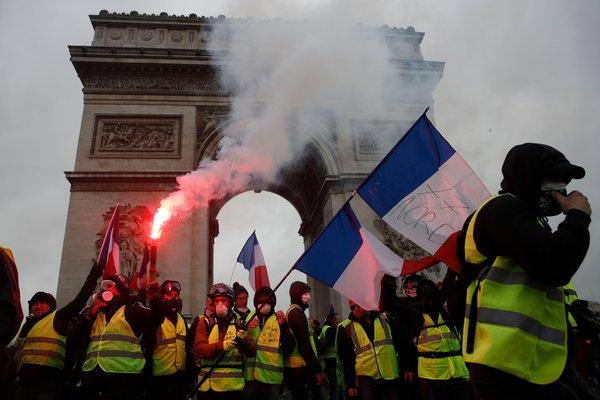
The most recent protests in France should worry the American political elite. The unrest was initially sparked by new fuel taxes but draws its energy from years of harsh neoliberal governance. Support among the numbers of protesters are vast, with many sides of the political spectrum trying to claim rights and co-op the movement. American political leaders, and specifically the Democratic party, should learn from these demonstrations and try to understand the roots of this turmoil.
As stated, the protests were first initiated by the French government’s announcement of new fuel taxes. The price of fuel has risen about 23 percent since the beginning of 2018, and around November, President Macron announced new taxes on fuel that would further raise prices. The cost of a gallon of diesel – the most used form of fuel for cars in France – is about $6.53 (USD). The hike in prices most heavily effects people that live in more rural areas that have to commute for work and school. This also comes at a time when continued cuts to public transit make people more dependent on their cars. On November 17th , 2018, frustration turned into action. Thanks to a grassroots online movement, thousands of people took to the streets to voice their opposition to these rising gas prices. The protesters wore the bright yellow vests that all motorists are required to keep in their cars by law.
The new taxes were supposed to be a part of the government’s new environmental agenda, which Macron said were necessary to protect the environment and combat climate change. What eventually became known was that only a mere 20% of revenue raised by the new taxes would go to environmental programs. The government used the pretext of climate change to further pillage the working class. This comes at a time when the working class of France is struggling to survive. After years of cuts and austerity, the middle and lower classes of French society are being economically suffocated. This can be traced as far back as 1983 when the government at the time enacted controversial austerity policies. This trend has continued ever since, with the French social welfare state being slowly chipped away. This mirrors events in the U.S. and the UK with Ronald Reagan and Margaret Thatcher. More recently, Macrons government has been criticized for an agenda that favors the wealthy over working class people.
Emmanuel Macron, a banker with a career in finance, won his bid for president in a landslide that was partly due to the fact that he ran against an evident racist, Marine le Pen. The young charismatic politician ran as the anti-Trump, but also tried to separate himself from the French political establishment which, like the U.S., is not very popular at the moment. Macron was endorsed by President Obama and heralded as a progressive savior. His time in office has proven that this couldn’t be further from the truth. His government abolished an important tax on the wealthy, the Solidarity Wealth Tax, which was a boon of $4 billion dollars to the richest members of French society. In his 2018 budget, he established a flat tax on capital which allowed an additional $10 billion to be transferred to the upper class. At the same time, Macron has led an assault on labor unions and cut services that average French citizens depend on. He raised income taxes on pensioners while also stopping these pensions to be indexed for inflation. The government has also lowered the amount given for housing contributions to people struggling to meet housing demands.
This is nothing more than a literal redistribution of money from the bottom to the top – socialism for the rich with harsh rugged capitalism for the working class and the working poor. This is also similar to what is going on in the rest of the world, the U.S. included. The new fuel taxes have proven to be the final element in a long line of measures that are strangling the working class in France. This fight has brought many parts of French society together in solidarity. The makeup of the protesters is broad, with most of the participants saying they have never participated in any kind of protest before. A completely grassroots movement, it has no official leader and no organizational structure. This has unfortunately allowed nefarious groups to try and co-op the movement. The French far-right was quick to latch onto the protests and insert its brand of anti-tax, anti-environmental and even anti-immigrant rhetoric. Even the American right quickly claimed that the movement was due to high taxation and anti-environmental sentiment. Fox news ran stories making these claims with President Trump parroting them soon after. While the American media and French far-right has tried to paint this movement as big government gone wrong, the broader complaint is of the unfair tax system where the rich have done very well under Macron.
While a specific tax prompted this unrest, the French people are not opposed to progressive taxation and efforts to protect the environment. Polling shows that both are important to French citizens. The grievance is that both are being unevenly shouldered on the working class and not the rich. The burden of alleviating climate change instead should be shifted to the large corporations that are most responsible for climate change instead of the most vulnerable members of society. The attention of the protesters soon turned to Macron himself. His reputation and policies had already dubbed him the ‘president of the rich’, and his harsh response to the movement didn’t help. Many of his statements showed his disdain and lack of empathy for the working class and the poor. In one speech he stated he loved train stations because there you can cross paths with ‘people who succeed’ and ‘people who are nothing’. In the French media it was reported that he told an unemployed man that instead of ‘kicking up bloody chaos’ he should go find a job, unable to fathom that the very reason for much of this unrest is lack of well-paying jobs and the cutting of the programs designed to aid average citizens. His arrogance and tone-deaf response have prompted the protesters to call for his resignation.

Sensing an unsustainable path because of civil unrest, the government conceded on some of their plans – even though Macron and his government initially vowed to never give in. The president announced that the scheduled fuel tax would be postponed, and the minimum wage would be raised. Most ironically, when Macron announced these changes he did so in a gilded golden room of the Élysée Palace. The optics of this could not have been worse for someone that is already seen as out of touch and disdainful of the working class.
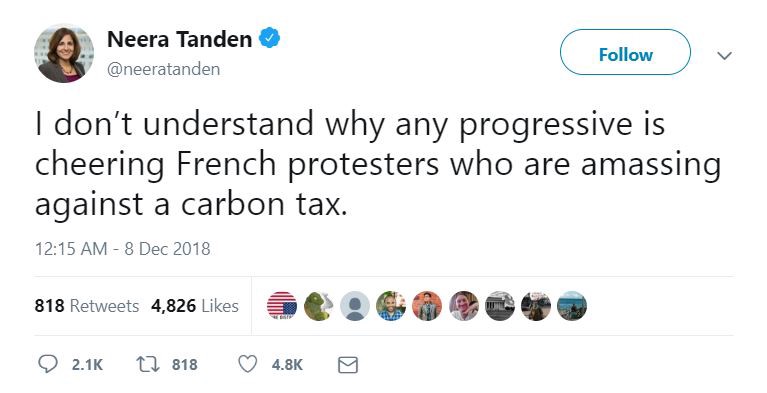
Sadly, some in the American liberal and Democratic establishment rushed to side with Macron and the Carbon tax. Neera Tanden, the President of the Center for American Progress – a third way centrist liberal organization, tweeted: “I don’t understand why any progressive is cheering French protesters who are amassing against a carbon tax.” These elitist so-called progressives are out of touch with working class people and are unable to realize that people are struggling and morally shouldn’t shoulder the burden of climate action, especially given the fact that large multi-national corporations are primarily responsible for the effects of climate change. Journalist Glenn Greenwald commented on these reactions, “The inability of rich neoliberal centrist elites in western capitals to understand – or even hide their scorn for – the anger & grievances of rural and working-class people over their economic suffering is one of the 2 or 3 most important causes of contemporary political changes.”
Growing income inequality and mistrust of the government’s ability to have the best interests of working people will only lead to more unrest. Martin Luther King repeatedly said that riots were the language of the unheard. When everyday citizens believe that they have no real channel to voice their opinions or anger, they have no other option. These protests are the result of this frustration. We must stand in solidarity with working class people around the world and work towards creating an international movement for the fair and just society we want to live in. The protests in France should be a lesson to the rest of the world and more specifically to the American political elite. The insurgent campaign of Bernie Sanders on the left shows people are unhappy with the direction of the establishment of the Democratic party. The embarrassing defeat of Hillary Clinton to the most disliked and scandal ridden candidate, Donald Trump, is proof that 30 plus years of crushing neoliberal politics has taken its toll on society. People are hungry for real substantial change. This is why Americans voted for the ‘hope and change’ candidate – Barack Obama. While Obama saved the country from falling off of an economic cliff, he didn’t go far enough, a corrupt and Wall Street funded Democratic party didn’t go far enough. It has been 10 years since the Great Recession began and the wealthy have recovered and are doing very well, while the rest of us are fighting over the scraps of whatever the rich decide to throw to us. People see this. People feel this. This is one reason, among many, why Donald Trump was able to win the presidency. Trump is but a symptom of a rigged system that will only get worse if substantial changes are not made. We cannot simply revert back to the status quo that was before Trump. If we do we will only be inviting the next Trump to take power, only next time we may get an intelligent and skilled politician instead of a bumbling imbecile.
Dale Seufert-Navarro
 to the LEFT