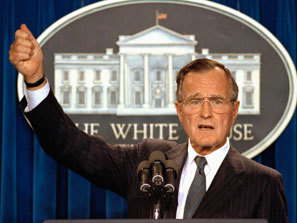
George H.W. Bush was a member of the House of Representatives, a United States Ambassador to the UN, director of the CIA, Vice President under Ronald Reagan, and finally the 41st President of the United States from 1989-1993. On November 30th Bush died at the age of 94. Since his death the media has showered the former president with adoration and praise, painting a very favorable picture of his time in the White House while glossing over the more inconvenient aspects. Columnists have said the late president represented civility and dignity. During his campaign and presidency Bush Sr called for a ‘kinder, gentler America’, but did his actions reflect this belief.
While there were some good things to come out of the Bush presidency — presiding over the end of the Cold War, standing up to the NRA, and signing the Americans with Disabilities Act — there are many problematic details about the first Bush’s term in office. Bush Sr was one of the most important men in modern history and to only focus on the positive parts of his legacy while ignoring the negative parts is dishonest and disingenuous.
As a gay man, the way Bush dealt with the AIDS crisis in the early 90s was disgraceful. The HIV/AIDS virus was discovered in 1981 but it took Ronald Reagan almost 4 years, not until the year 1985, to even utter the word AIDS in public. When Bush took office in 1989 he continued this policy of inaction and indifference. Although Bush signed the Ryan White Comprehensive AIDS Resources Emergency Act, his administration lacked urgency. As thousands continued to die, and activists demanded funding and treatment, Bush’s main response was of ‘personal responsibility’. LGBTQ activists famously sprinkled the ashes of fallen loved ones on the lawn of the White House in an effort to call attention to the epidemic.
George Bush Sr devastated Iraq in the Gulf War based on half-truths and lies and helped to ensure that American military intervention would be the default foreign policy for decades to come. At the time, Bush claimed the U.S. had no choice but to use force because Saddam Hussein had invaded Kuwait. Yes, the invasion of Kuwait violated international law, but many commentators now believe that the U.S., through its ambassador to Iraq, essentially gave Hussein the green light to invade Kuwait in order to have an excuse to invade Iraq. The U.S. bombed the Amiriyah Shelter, knowing full well that the site was being used for civilians, killing over 400 innocent lives. The Iraqi civilian infrastructure was devastated, also violating international law. Electrical power stations and food plants were bombed in an effort to cripple the country’s infrastructure in order to make Iraq dependent on international assistance after the war. Post-war sanctions further devastated the country. The administration also said that Saddam was preparing to invade Saudi Arabia with troops being deployed at the border. This turned out to be a lie as well. A reporter, at the time, purchased commercial satellite data and saw that in fact there were no troops at the Saudi border. Like his son to come, the administration used lies and misinformation to lead us into a war that cost the U.S. and Iraqi countless lives.
Many in the media have neglected to point out that Bush was criticized for helping to cover up potential crimes involving the Iran-Contra during the Reagan Era. During Ronald Reagan’s presidency the administration facilitated arms sales to Iran, in clear violation of an arms embargo, in order to raise money to fund the Contras in Nicaragua. At the time the Contras, favored by Reagan and the U.S. government, were in a struggle against the ruling Sandinista party. Right before the trial of Defense Secretary Caspar Weinberger, Bush issued pardons to him and many other individuals involved with the incident. The president also refused to cooperate with the investigation in which he was directly involved as Ronald Raegan’s Vice President. This seems all too familiar to the current situation with Trump and Robert Mueller.
Upon taking office Bush continued to ramp up the ‘War on Drugs’, which has had clear racial implications. During one of his first Oval Office press conferences, Bush displayed a bag of crack cocaine that he said was sold and confiscated right across the street from the White House. Bush wanted to show the American people that the crack epidemic was rampant in every corner of American society, but this was also a charade. The man that sold the crack cocaine to undercover DEA agents was in fact lured to the spot near the White House by agents in order to mislead the nation. The stunt was used by the administration to call for, in his words, more prisons, jails, and prosecutors. This was just the beginning of what was to become an incarceration nation, with the U.S. imprisoning more people than any other developed nation.
For all the talk of Bush being a civil and decent human being that wanted a ‘gentler and kinder’ America, journalists forget about the extremely racist Willie Horton ad during his 1988 presidential campaign. Even many Republican operatives at the time said that it went too far. The ad described a convicted rapist that was allowed a weekend furlough pass. While out he raped a young woman and killed her boyfriend. Their aim was to tie the incident to the Democratic candidate and stoke racial fear. Lee Atwater famously said at the time, “We’re going to talk about Willie Horton so much that people are going to think he’s Michael Dukakis’s running mate”. How is this not similar to the blatantly racist ad that the Trump administration put out before the 2018 midterm election about the traveling migrant caravan from Central America?
Let us also not forget that President bush sent troops into Panama to issue an arrest warrant for its leader, Manuel Noriega. The arrest warrant was for drug trafficking charges. Noriega was an ally to the U.S. and was even on the CIA payroll. We must remember that George H.W. Bush was once the director of the CIA, and during this period the U.S. government, through the CIA, frequently meddled in Central American affairs. Over 20,000 troops were deployed into the small Central American country, killing over 3,000 Panamanians. The move was seen by most of the international community as an illegal invasion of a sovereign country. The invasion of Panama was one of the first uses of military force after the end of the Cold War, and helped to introduce the U.S. policy of using force to ‘protect’ democracy around the world.
When any life is lost it always a somber time, especially for family and people close to the person lost, but death does not absolve a person of his or her sins. We must always be critical of our leaders and their legacies, no matter who they may be? The positive and the negative must be brought into the light. Introspection is a way to learn from our collective past. Journalists have a duty and responsibility to be critical of our leaders and current events, not just a mouthpiece for the government or the powerful. Patriotism does not mean that one must never criticize or question. Too often people use the threat of anti-patriotism or being anti-American has a way to crush dissent and debate. It is not blindly accepting the words and motives of our leaders. Instead, true patriotism is aspiring for your country to be better, holding it accountable to the ideals of freedom, respect, and liberty. We must never bow down to this threat and always strive to surpass even our own expectations. When we are gone, how will the next generation look back and judge our decisions?
Dale Seufert-Navarro
 to the LEFT