Everywhere you turn, you hear the word fascism. With Donald Trump’s affinity for violence and a superficial toxic masculine world view, the comparisons between him and historical fascist strongmen are not hard to connect. Because of all of this renewed discussion about fascism, I decided to explore the topic and its historical roots in America.
In 1944, at the height of World War II and the rise of the European fascists – Hitler, Mussolini, and Franco – the Vice President of the Unites States, Henry Wallace, wrote an op-ed in the New York Times warning about the influence and threats of fascist ideology taking root in America. While some of the content of his piece is distinct to the situation and time in which he wrote it, wartime 1940’s, it is still shockingly relevant to our modern era.
Before I posted my own piece on fascist ideology in American politics, I wanted to present Henry Wallace’s entire NYT op-ed article to highlight him in his own words. As you read his piece, imagine the world he faced and the circumstances that created that world. Now look around at the world us today. What are its warnings? What are its parallels?
Dale Seufert-Navarro
*************************************************************************************
An article from the New York Times, April 9, 1944.
From Henry A. Wallace, Democracy Reborn (New York, 1944), edited by Russell Lord, p. 259
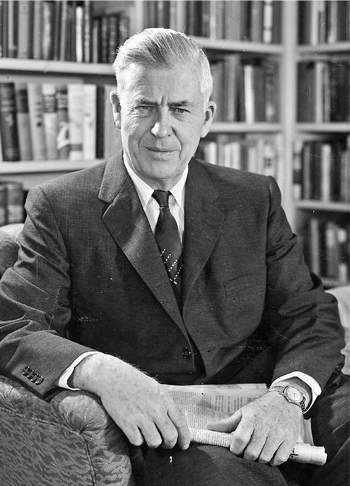
On returning from my trip to the West in February, I received a request from The New York Times to write a piece answering the following questions:
- What is a fascist?
- How many fascists have we?
- How dangerous are they?
A fascist is one whose lust for money or power is combined with such an intensity of intolerance toward those of other races, parties, classes, religions, cultures, regions, or nations as to make him ruthless in his use of deceit or violence to attain his ends. The supreme god of a fascist, to which his ends are directed, may be money or power; may be a race or a class; may be a military, clique or an economic group; may be a culture, religion, or a political party.
The perfect type of fascist throughout recent centuries has been the Prussian Junker, who developed such hatred for other races and such allegiance to a military clique as to make him willing at all times to engage in any degree of deceit and violence necessary to place his culture and race astride the world. In every big nation of the world are at least a few people who have the fascist temperament. Every Jew-baiter, every Catholic hater, is a fascist at heart. The hoodlums who have been desecrating churches, cathedrals, and synagogues in some of our larger cities are ripe material for fascist leadership.
The obvious types of American fascists are dealt with on the air and in the press. These demagogues and stooges are fronts for others. Dangerous as these people may be, they are not so significant as thousands of other people who have never been mentioned. The really dangerous American fascists are not those who are hooked up directly or indirectly with the Axis. The FBI has its finger on those. The dangerous American fascist is the man who wants to do in the United States in an American way what Hitler did in Germany in a Prussian way. The American fascist would prefer not to use violence. His method is to poison the channels of public information. With a fascist the problem is never how best to present the truth to the public but how best to use the news to deceive the public into giving the fascist and his group more money or more power.
If we define an American fascist as one who in case of conflict puts money and power ahead of human beings, then there are undoubtedly several million fascists in the United States. There are probably several hundred thousand if we narrow the definition to include only those who in their search for money and power are ruthless and deceitful. Most American fascists are enthusiastically supporting the war effort. They are doing this even in those cases where they hope to have profitable connections with German chemical firms after the war ends. They are patriotic in time of war because it is to their interest to be so, but in time of peace they follow power and the dollar wherever they may lead.
American fascism will not be really dangerous until there is a purposeful coalition among the cartelists, the deliberate poisoners of public information, and those who stand for the K.K.K. type of demagoguery.
The European brand of fascism will probably present its most serious postwar threat to us via Latin America. The effect of the war has been to raise the cost of living in most Latin American countries much faster than wages of labor. The fascists in most Latin American countries tell the people that the reason their wages will not buy as much in the way of goods is because of Yankee imperialism. The fascists in Latin America learn to speak and act like natives. Our chemical and other manufacturing concerns are all too often ready to let the Germans have Latin American markets, provided the American companies can work out an arrangement which will enable them to charge high prices to the consumer inside the United States. Following this war, technology will have reached such a point that it will be possible for Germans, using South America as a base, to cause us much more difficulty in World War III than they did in World War II. The military and landowning cliques in many South American countries will find it attractive financially to work with German fascist concerns as well as expedient from the standpoint of temporary power politics.
Fascism is a worldwide disease. Its greatest threat to the United States will come after the war, either via Latin America or within the United States itself.
Still another danger is represented by those paying lip service to democracy and the common welfare, in their insatiable greed for money and the power which money gives, do not hesitate surreptitiously to evade the laws designed to safeguard the public from monopolistic extortion. American fascists of this stamp were clandestinely before the war, and are even now preparing to resume where they left off, after “the present unpleasantness” ceases.
The symptoms of fascist thinking are colored by environment and adapted to immediate circumstances. But always and everywhere they can be identified by their appeal to prejudice and by the desire to play upon the fears and vanities of different groups in order to gain power. It is no coincidence that the growth of modern tyrants has in every case been heralded by the growth of prejudice. It may be shocking to some people in this country to realize that, without meaning to do so, they hold views in common with Hitler when they preach discrimination against other religious, racial or economic groups. Likewise, many people whose patriotism is their proudest boast play Hitler’s game by retailing distrust of our Allies and by giving currency to snide suspicions without foundation in fact.
The American fascists are most easily recognized by their deliberate perversion of truth and fact. Their newspapers and propaganda carefully cultivate every fissure of disunity, every crack in the common front against fascism. They use every opportunity to impugn democracy. They use isolationism as a slogan to conceal their own selfish imperialism. They cultivate hate and distrust of both Britain and Russia. They claim to be super-patriots, but they would destroy every liberty guaranteed by the Constitution. They demand free enterprise but are the spokesmen for monopoly and vested interest. Their final objective toward which all their deceit is directed is to capture political power so that, using the power of the state and the power of the market simultaneously, they may keep the common man in eternal subjection.
Several leaders of industry in this country who have gained a new vision of the meaning of opportunity through cooperation with government have warned the public openly that there are some selfish groups in industry who are willing to jeopardize the structure of American liberty to gain some temporary advantage. We all know the part that the cartels played in bringing Hitler to power, and the rule the giant German trusts have played in Nazi conquests. Monopolists who fear competition and who distrust democracy because it stands for equal opportunity would like to secure their position against small and energetic enterprise. In an effort to eliminate the possibility of any rival growing up, some monopolists would sacrifice democracy itself.
It has been claimed at times that our modern age of technology facilities dictatorship. What we must understand is that the industries, processes, and inventions created by modern science can be used either to subjugate or liberate. The choice is up to us. The myth of fascist efficiency has deluded many people. It was Mussolini’s vaunted claim that he “made the trains run on time.” In the end, however, he brought to the Italian people impoverishment and defeat. It was Hitler’s claim that he eliminated all unemployment in Germany. Neither is there unemployment in a prison camp.
Democracy to crush fascism internally must demonstrate its capacity to “make the trains run on time.” It must develop the ability to keep people fully employed and at the same time balance the budget. It must put human beings first and dollars second. It must appeal to reason and decency and not to violence and deceit. We must not tolerate oppressive government or industrial oligarchy in the form of monopolies and cartels. As long as scientific research and inventive ingenuity outran our ability to devise social mechanisms to raise the living standards of the people, we may expect the liberal potential of the United States to increase. If this liberal potential is properly channeled, we may expect the area of freedom of the United States to increase. The problem is to spend up our rate of social invention in the service of the welfare of all the people.
The worldwide, agelong struggle between fascism and democracy will not stop when the fighting ends in Germany and Japan. Democracy can win the peace only if it does two things:
- Speeds up the rate of political and economic inventions so that both production and, especially, distribution can match in their power and practical effect on the daily life of the common man the immense and growing volume of scientific research, mechanical invention and management technique.
- Vivifies with the greatest intensity the spiritual processes which are both the foundation and the very essence of democracy.
The moral and spiritual aspects of both personal and international relationships have a practical bearing which so-called practical men deny. This dullness of vision regarding the importance of the general welfare to the individual is the measure of the failure of our schools and churches to teach the spiritual significance of genuine democracy. Until democracy in effective enthusiastic action fills the vacuum created by the power of modern inventions, we may expect the fascists to increase in power after the war both in the United States and in the world.
Fascism in the postwar inevitably will push steadily for Anglo-Saxon imperialism and eventually for war with Russia. Already American fascists are talking and writing about the conflict and using it as an excuse for their internal hatreds and intolerances toward certain races, creeds and classes.
It should also be evident that exhibitions of the native brand of fascism are not confined to any single section, class, or religion. Happily, it can be said that as yet fascism has not captured a predominate place in the outlook any American section, class, or religion. It may be encountered in Wall Street, Main Street or Tobacco Road. Some even suspect that they can detect incipient traces of it along the Potomac. It is an infectious disease, and we must all be on our guard against intolerance, bigotry, and the pretension of invidious distinction. But if we put our trust in the common sense of common men and “with malice toward none and charity for all” go forward on the great adventure of making political, economic and social democracy a practical reality, we shall not fail.
Henry Wallace

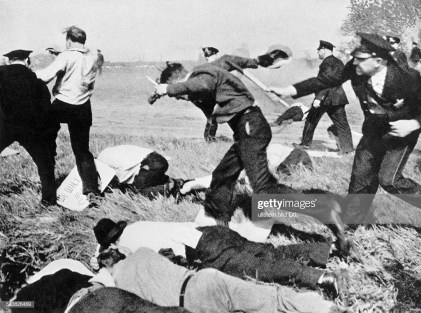 Youngstown Steel Mill Strike –Photo by Archiv Gerstenberg/ullstein bild via Getty Images
 to the LEFT